Introduction
Simultaneous interpreting is a complex task in which interpreters need to develop certain coping skills to effectively exploit their cognitive strengths and manage their weaknesses. Despite their expertise, even the most professional simultaneous interpreters may face barriers which affect their competencies to sustain high-quality performance (Moser-Mercer, 2000, p. 90). Even though translation and interpreting share common phenomenological research grounds, such as "the sociology of translation and interpreting; cultural issues pertaining to translating and interpreting; perspectives of identity or (in)visibility; didactics and methodology (descriptive or explanatory)” (Grbić & Wolf, 2012, p. 7), there is a clear-cut difference between the two activities. According to Baker (2001), the key difference lies in the processing conditions and time allocated for the target text.
Along the same line, even though the phenomenon of correction has been extensively studied in translation, this process works differently for conference interpreters. Unlike translators, interpreters had long been perceived as not having the luxury of revisiting and refining their output. Therefore, for a long time, the notion of "correctability" has operated under different constraints in simultaneous interpreting (Mirek, 2023, p. 28), referring to interpreters' need to make real-time decisions and adapt quickly to ensure accuracy and coherence. Nevertheless, as Mirek (2022, p. 4) noted, this perception was challenged by Lederer (1981, p.137), indicating that simultaneous interpreters are, in fact, able to assess their outputs and make adjustments to control their accuracy and coherence. In this sense, applying self-repairs in simultaneous interpreting can be understood as a strategy to maintain control over their performance (Mirek, 2022, p. 4).
The term "repair" was initially introduced by Schegloff, Jefferson, and Sacks (1977) and mainly described as an error correction. However, Schegloff et al. (1977, p. 363) further indicate that repairs can also be found even "where there is no hearable error, mistake, or fault”. Repairs can be initiated by the speakers themselves as a "self-initiated repair" or by another conversation participant as an "other-initiated repair" (Schegloff et al., 1977). Schegloff et al. (1977) distinguish 4 types of repairs based on the initiator: self-initiated self-repair, self-initiated other repair, other-initiated self-repair, and other-initiated other repair.
Levelt (1983, p.45), on the other hand, relates repair to speakers' language control mechanisms in which he states that:
In order to make a repair, the speaker must, firstly, notice some trouble and interrupt his or her flow of speech, and, secondly, create a new utterance, which takes care of the trouble and its potential consequences for the listener. (Levelt, 1983, p.45)
According to Levelt (1983, p. 2), self-repair occurs in three phases. The first phase entails the self-monitoring process of the speaker in which "a speaker is continuously parsing his own inner or overt speech" (Levelt, 1983, p.42). The speech is interrupted when the speaker detects a problem in this phase. The second phase involves hesitation, pause, and editing terms. It is the final phase where repair and a new utterance take place. In this sense, self-repair comes into play as an important strategy in a conversation to prevent misunderstanding and maintain a mutual understanding between the parties, in the case of any disruption (Liddicoat, 2007). Self-repair, according to Gilabert (2013, p.575), both in first and second language production, is a "widespread phenomenon" since it encompasses detecting problems that lead to interruption of the flow of a speech, and then provides an opportunity to repair it.
Self-repair can also be found in interpreting, and it was first introduced as an interpreting strategy by Kohn and Kalina in 1996 (Shen & Liang, 2021, p. 763). Since then, self-repair has been researched from angles such as directionality (Dailidenaite, 2009), content and form (Zhang & Song, 2019), norms (Magnifico & Defrancq, 2019), gender (Paice, 2022), and in remote interpreting (Vranjes & Defranq, 2024), both in conference and community interpreting settings, focusing on professional and/or trainee interpreters. Yet, self-repairs across different speech types in simultaneous interpreting are still under-researched. To bridge this gap in the literature, this study will attempt to scrutinize the self-repairs initiated by 7 senior student interpreters during English-to-Turkish simultaneous interpreting in two speech types, i.e., medical and legal, and their motivations behind these repairs. For the purpose of the study, the focus will be on the "self-initiated self-repairs" (Schegloff et al., 1977), and the term "self-repair" refers not only to an error correction but also to a self-initiated repair sequence addressing a "trouble" by student interpreters. The reason for this is that "repairing an utterance will be seen as matching the output against fitness for purpose rather than simply as the correction of errors" (Petite, 2005, p. 30). To this end, this study set out to answer the following research questions:
- What are the most common forms of self-repair in English-Turkish simultaneous interpreting in legal and medical speeches?
- Is there a difference in the number of self-repairs produced by student interpreters across different speech types?
- What are the main motivations behind these self-repairs?
Analyzing student interpreters' self-repairs in simultaneous interpreting of these two types of speeches might provide practical contributions, since repairs "denote students' awareness of form and can be interpreted as learners' attempts of being accurate" (Kormos, 1999, as cited in Gilabert, 2013, p. 577). As simultaneous interpreting entails a great cognitive load, analyzing students' self-repairs might provide both theoretical and practical implications regarding their monitoring mechanisms and progress. Analysis of the type and frequency of self-repairs in these two main speech types might further reveal students' incompetencies in different speech types, and provide an opportunity for improvement. Researching the student interpreters' motivations for self-repairs might also be an effective training tool to test their awareness regarding their deficiencies.
Moreover, this study contributes to our methodological understanding of self-repair mechanisms in simultaneous interpreting since it integrates both product- and process-oriented approaches. This experimental research provides a broader perspective on the issue because it "allows to control variables impossible to eliminate in observational studies" (Gumul, 2017, p. 14). The transcriptions of recordings during the experiment are corroborated with the post-experiment questionnaire and reflective reports to allow an in-depth analysis of self-repairs and the underlying motivations. Thus, the product-oriented comparative analysis of source text (ST) and target text (TT) (students' outputs) is triangulated with a process-oriented reflective analysis of student reports.
(Self)-Repair Strategies in Interpreting Studies
The issue of (self) repairs in interpreting process has sparked academic debates over the years. Several studies investigate the phenomenon of repair mechanisms in different interpreting modes in both community (Zhao & Huang, 2025) and conference interpreting settings (Zhang & Song, 2019; Tang, 2020). However, it was first introduced as an interpreting strategy by Kohn and Kalina (1996), who described self-repair as an emergency strategy for failed comprehension and production strategies (Shen & Liang, 2021, p. 763; Dailidenaite, 2009, p. 11). As indicated by Dailidenaite (2009, p.12), Kalina (1998) proposed different repair strategies such as replacement, completion, approximation, and relativation. Completion strategy is adopted for an incomplete sentence by starting a new sentence, while replacement refers to "replacing an already-produced segment with another" (Dailidenaite, 2009, p. 11). The other two strategies- approximation and relativation- bring the interpreters closer to the ST without disrupting the fluency of the speech (ibid). After examining authentic data from the corpus of eight professional interpreters' recordings at four international conferences from English into German and French, Petite (2004, 2005) presented another taxonomy of repair strategies, slightly amending Levelt's (1983) nomenclature of repairs in spontaneous speech. She divided repairs into two, namely "input-generated repairs" in which the interpreter "might realize that s/he departed from the source text and wishes to repair his/her output because of the input”, and "output- generated repairs" in which the interpreter clarifies his/her rendition for the audience (Petite, 2004, p. 45). The former is source-text oriented repairs, while the latter refers to target-text oriented repairs. Dailidenaite (2009, p. 17), on the other hand, further broadened the typology of self-repair by including "no repair" (the interpreter's choice of not repairing anything) and "delayed repair" (delaying the repair in order to balance the processing capacity "at a certain distance from the original output”). In a more recent analysis of similarities and differences between professional and student interpreters' self-repairs and their motivations, Shen and Liang (2021) developed a new taxonomy which consists of five major self-repairs: repetition, restart, replacement, rephrasing, and delayed repair. "Repetition" occurs when "the interpreter repeats one or more lexical items" (Shen & Liang, 2021, p. 768). The interpreter might also opt for "restart" strategy by "restarting a new statement before the completion of the previous one" (ibid). "Replacement" strategy occurs when "the interpreter corrects phonological, lexical, grammatical and syntactic errors with immediate replacement" (ibid). The final two strategies, "rephrasing" and "delayed repair" refer to making the meaning of the original input more explicit and improving a word or a phrase "said again by the original speaker”, respectively (ibid). This research adopts Shen and Liang's (2021) self-repair strategies in the analysis part due to their broad scope and recency. Existing literature provides in-depth and valuable insights into self-repair in interpreting studies, though there remains a gap in the literature as to how self-repair manifests itself in different speech types. According to a recent industry report, medical and legal are the two most common translation specialisms (ELIA et al., 2023, p. 27), which encapsulate distinct challenges ranging from specialised terminology to context (Chereji, 2024, pp. 41- 42). Given the distinct challenges in these speech types, it seems timely to explore the points of convergence and divergence in medical and legal simultaneous interpreting regarding self-repair strategies, along with the underlying motivations.
Gile's Effort Model in Simultaneous Interpreting
At the beginning of the 1970s, it became clear that simultaneous interpreting is not merely about a direct transfer of words and sentence structures between languages, instead, it is an act which is "mediated by some form of cognitive representation in memory" (Pöchhacker, 2004, p. 59). As Giles (1999) noted, a number of scholars such as Gerver (1976), Moser (1978), Setton (1997), Paradis (1994), and Mizuno (1994, 1995), have developed their own models based on the theoretical constructs in cognitive psychology, neurolinguistics, and linguistics, for example.
According to Gile (1999, 2009), simultaneous interpreting can be conceived as a process containing three core efforts, namely Listening and Analysis Effort (L), Memory Effort (M), Production Effort (P), and an additional Coordination Effort (C). Namely, the Effort Model for simultaneous interpreting (SI) is outlined as follows:
SI= L + M + P + C
The results of this study are to be discussed in relation to these different types of effort. It seems a suitable approach since the model was originally designed for educational purposes and is central to Gile's teaching of interpreting (Gile, 2009, p. 158), and the participants in this study are trainees.
Method
Research Design
In this study, a mixed-method approach was adopted to thoroughly explore the self-repairs made by student interpreters as well as their motivations, and to shed light on the ‘why's of their experiences. The aim is not to reach generalizable results, but rather, to scrutinize "a contemporary phenomenon in depth and within its real-life context" (Yin, 2009, p.18). Taking into consideration the definition of a case as "a unit of human activity embedded in the real world; which can only be studied or understood in context; which exists in the here and now" (Gillham, 2000, p.1), self-repairs in simultaneous interpreting can also be regarded as a suitable focus for a case study since this phenomenon can be observed in real-life and real-time conditions (Saldanha & O'Brien, 2014). To enhance validity and gather comprehensive insights into self-repairing in two different speech types, multiple data collection methods were used, including an experiment, a questionnaire, and student reports. In what follows, each of these methods will be explained in detail.
Experiment
Participants
The sample consisted of 7 subjects at the same level of university training in Türkiye. All were senior translation and interpreting studies students at a major university in Izmir who enrolled in the Simultaneous Interpreting course during the 2023-2024 Spring semester. In terms of their interpreting competence, they all completed compulsory interpreting courses such as Introduction to Interpreting, Sight Interpreting, and Consecutive Interpreting in the same T & I program. Of the 7 student interpreters, 2 were male and 5 were female, all aged between 21 and 23. They were all native Turkish speakers and spoke English as their second language. The researcher explained the aim of the study to all participants and obtained informed consent for their participation. Anonymity was guaranteed by using pseudonyms such as INT1, INT2.
Material
The legal speech for the simultaneous interpreting task was excerpted from the website of the Parliamentary Assembly of the Council of Europe, and the medical speech was taken from the European Commission's speech repository. Both speeches were delivered in English by the researcher. The main selection criterion for speech texts was a similar frequency of terms to ensure the comparability of medical and legal speeches. To rule out the probable effects of factors such as accent and speed in the main predictor topic, both speech texts were read at the same speed. More detailed information on the interpreting materials used in the experiment can be found in the Tables 1 and 2 below:
| Topic | Genre | Speaker | Intonation/ Accent | Length (characters) |
|---|---|---|---|---|
| A healthy diet | Medical speech | Female | Neutral | 757 words |
| Topic | Genre | Speaker | Intonation/ Accent | Length (characters) |
|---|---|---|---|---|
| Human rights and solidarity in Europe |
Legal speech | Female | Neutral | 797 words |
The speaking rate for both speeches of the speaker was similar. Both speeches addressed relatively general topics, with which the student interpreters were expected to have been familiar. The speeches focused on the invasion of Ukraine and healthy eating, respectively, which required no in-depth preparation for interpretation.
Procedure
Before the task, the students were given an overview of the experimental procedure, and to ensure the ecological validity, they were asked to imagine themselves in a real conference setting. First, the students were given Turkish equivalents for the possible unfamiliar terms from the legal and medical speech texts to eliminate the terminology and difficulty variables, which they were allowed to use during the task. Next, the experiment was held at soundproof booths at the simultaneous interpreting laboratory, where regular interpreting classes are held. The experiment was divided into two sections; first, the students rendered the medical speech, and then the legal speech, both were interpreted simultaneously. Their interpreting performances were recorded and then transcribed manually. The students were given a questionnaire immediately after, asking them to listen to and evaluate their performance in both speeches. All experimental procedures, including the questionnaires, obtained Ethics Committee approval from the university and were conducted in line with the approved guidelines.
Questionnaire
To compare and contrast their insights into their performances in both speech types, both multiple-choice and yes/no questions were included.
The questionnaire was divided into two main sections. The first consisted of demographic, educational, and experience background questions to obtain contextual information. In the second section, students were asked to rate their own performances in both speech types, providing insights into how they evaluated their strengths and weaknesses. Then, the students were asked to identify the strategies they applied during the simultaneous interpreting task from the strategy list provided in the questionnaire. However, the responses for this final section were excluded from the analysis since they are not within the scope of this article.
By incorporating closed-ended questions and performance ratings, the questionnaire set out to obtain both quantitative and qualitative data, providing a comprehensive view of the students' reflections on their performances.
Reflection-on-Action: Student Reports
Experiential learning suggests that learning is "the process whereby knowledge is created through the transformation of experiences" (Kolb, 1984, p. 49). Taking this as a departure point, several scholars (such as Boud et.al., 1985; Kolb, 1984; Schön, 1983) agreed that experience alone is not sufficient for learning; rather, reflection on one's experience is essential (Cattaneo & Motta, 2021, p. 186). The concept of reflection on practices or actions to foster professional development was first introduced by John Dewey in the 1920s. In the 1980s, the term "reflective practice" was coined by educational theorist Donald Schön in his book, The Reflective Practitioner (Schön, 1983, as cited in Dean, 2021, p. 250). He used different terms to define the concept of reflective practices, i.e., "reflection-in-action" and "reflection-on-action" (Schön, 1987). The former refers to "thinking while doing”, while the latter describes "after-the-event-thinking" (Moghaddam et al., 2019, p. 278). In other words, reflection-on-action is "carried out after the action is performed" (Manrique & Sánchez Abchi, 2015, p. 14).
This study adopts Schön's (1983/1987) concept of "reflection-on-action”. Based on this approach, students listened to and wrote an evaluation report on their interpreting performances. Source text transcriptions were shared with the students to help them recall their performance. This teaching method can be considered as a means of providing students with access to insights into their practices since "it allows to make explicit what otherwise would be left in the dark" (Manrique & Sánchez Abchi, 2015, p. 14). By reflecting on their performances, they could gain awareness regarding their strengths and weaknesses, which may contribute to their future professional development.
Data Analysis
The data obtained in this research were analyzed through a three-step process. In the first stage, a statistical analysis was conducted, which involved listening to the students' recordings and identifying and classifying self-repair strategies according to Shen and Liang's (2021) categorization. Each identified self-repair form- namely, repetition, restart, replacement, rephrase, and delayed repair- was manually counted, and their frequencies were calculated as percentages for each of the two speech types. The data were also analyzed qualitatively by assessing the students' recorded output. In the subsequent phase, the results gathered from the post-experiment questionnaire were examined quantitatively. In the final step, results from the quantitative data analysis were complemented by a thematic analysis of students' reflections on their recordings to explore the motivations behind their self-repair strategies. Themes were determined based on the principles of recurrence and repetition (Owen, 1984). For instance, if a concept or idea was expressed by two or more interpreters, it was categorized as a theme. By including qualitative and quantitative data, the study intended to establish validity and credibility through triangulation.
Results
Post-Experiment Questionnaire
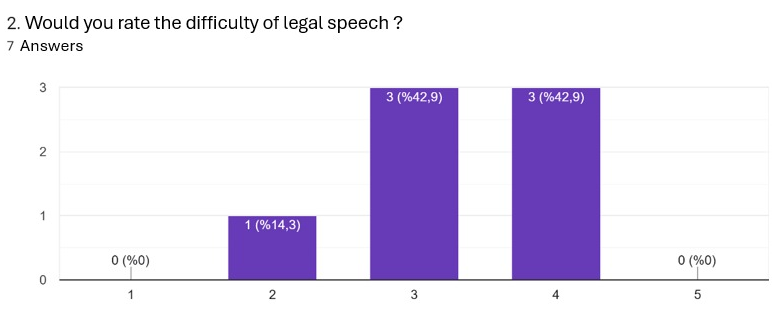
In order to identify any correlation between the students' self-perceptions of text difficulty and their performance, they were asked to rate the texts from 1 (not difficult) to 5 (very difficult). The questionnaire showed that the medical speech text was considered more difficult, with an average rating of 4.43, and the legal text, easier, with an average rating of 3.29 (see Figures 1 and 2):
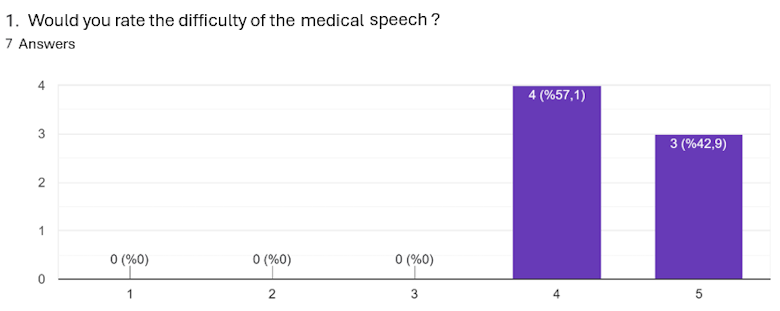
As can be inferred from Figure 1 above, four students rated the difficulty of the medical speech as 4, while three students rated it as 5. These points dropped off in the legal speech text (see Figure 2):
The students' self-evaluation of their performances revealed similar results for both speeches. The students were asked to rate their performance from 1 to 5, where 1 means "no satisfaction" and 5 means "complete satisfaction”. The results of which are given below in Figures 3 and 4:
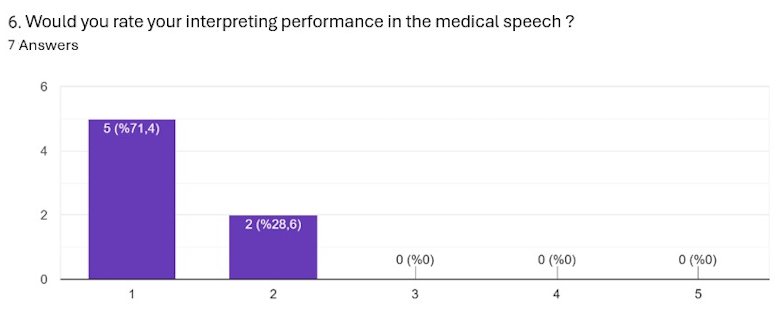
It can be seen that the majority of the students (n=5) were not satisfied with their interpreting performance in the medical speech, where all rated it as 1, except for two students, who rated it as 2. However, the ratings of the legal speech performances revealed a divergence. Even though there is variation in ratings, the average rating is higher than that of the medical speech. Specifically, three students rated their performance as 3, two students as 2, one student as 1, and one student as 4 (see Figure 4):
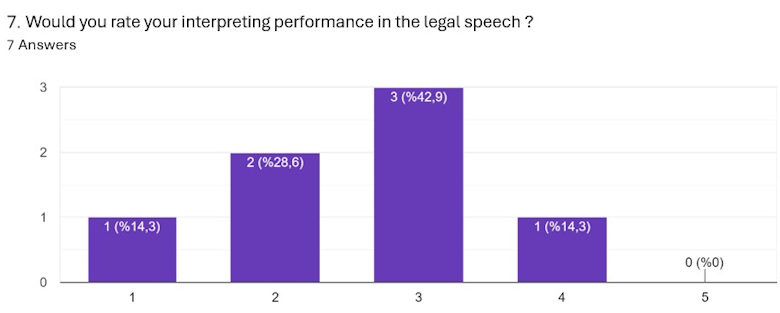
As can be seen above, none were completely satisfied in either case. However, they believed that their interpreting performance was better in the legal speech when compared to the medical speech. Regarding the effect of distance, three students were "not sure”, three responded "yes”, while only a single student responded "no”. When further asked the reasons, those who responded "yes" pointed out the technical challenges of distance. Thus, distance was not found to be an important factor impacting self-repairs in this research.
Distribution of self-repair forms in legal and medical speech
Statistical analysis was conducted for each type of repair form within the corpus. In this study, a total of 216 self-repair forms (134 in legal and 82 in medical speech) were identified. As shown in Figures 5 and 6 below, a statistical difference was found between the speech types, with more self-repairs made in the legal than the medical speech.
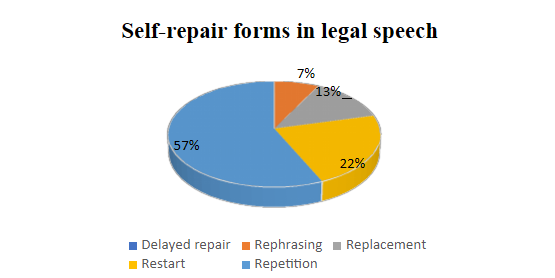
In the legal speech, the most frequently used type of self-repair was repetition (57%, n= 76), followed by restart (22%, n=30), replacement (13%, n= 18), and rephrasing (8%, n=10). In the medical speech, a significantly different distribution of repairs was found (see Figure 6):
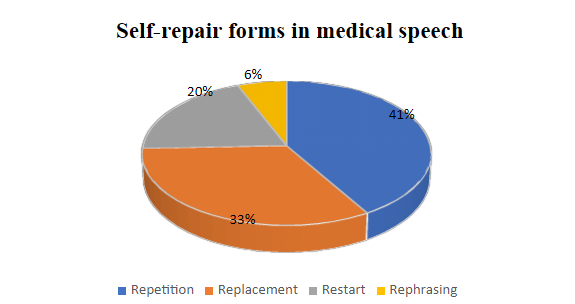
In the medical speech, similarly, repetition (41%, n=34) was the most frequent type of self-repair, followed by replacement (33%, n=27), restart (20%, n=16), and rephrasing (6%, n=5). No delayed repair technique was observed in either speech.
A comparative analysis clearly shows that repetition is the most frequently employed self-repair form in both speech types. Nevertheless, the total number of self-repairs is much higher in the legal speech than in the medical one. More specifically, the use of repetition strategy alone in the legal speech is nearly twice as frequent as in the medical speech, providing potentially valuable insights into these students' competencies and shortcomings in different speech types.
Motivations for Self-repairs in Legal and Medical Speech
The thematic analysis of the reflective reports revealed that common motivations were found for both types. The results showed that challenges stemming from syntactic asymmetries, cognitive load, and lack of short-term memory (STM) triggered student interpreters to self-repair their renderings to achieve semantic coherence in both legal and medical speeches, to be discussed in more detail below. Due to space limitations, each theme is illustrated by a few representative examples from one or both speeches. Excerpts from the student interpreters' recordings are compared with their statements in the reports to consolidate the discussion. In these excerpts below, abbreviations will be used for the participants. The letter "S" stands for a speaker and "INT" stands for an interpreter.
Syntactic Challenges
The majority of the students (n = 4) indicated that syntactic challenges led to self-repairing. The main triggers were identified as complex sentence structures, differing word orders between ST and TT, conjunctions, and relative clauses. These challenges often led to self-repair strategies such as repetition, restart, and replacement. For example, INT1 reported having difficulties connecting the beginning and the end of the sentence after starting to render the speaker, without waiting for the complete meaningful unit. This prompted them to repeat or restart to ensure the interpretation's clarity and semantic coherence.
[E]specially when it comes to complex or compound complex sentences where lots of elements are linked with conjunctions or relative clauses. Because I'm afraid I will fall behind, I generally start rendering the speech without waiting for a meaningful unit to be uttered by the speaker, causing me to forget my line of thought when other linked elements are presented later on. Therefore, I not only cannot remember the sentence itself while dealing with the reformulation process in my mind, but I also forget how I've started rendering in the first place, since my mind is too focused on reformulating than actually listening and remembering. (INT1)
The same challenge was highlighted by INT3, indicating that they had to split the sentence because of switching to a different sentence structure, thus repeating the same word. Example 1 illustrates a typical scenario where INT3 made repetition in the medical speech:
EX1: S: I'm delighted to have the honour of opening this international conference on the Joint Programming Initiative "A Healthy Diet for a Healthy Life".
INT1: Bugün bu uluslararası konferansı açmaktan onur duyuyorum. Daha "Sağlıklı Bir Beslenme ve Hayat Biçimi" için Ortak Program Girişimi'dir bu konferans .
Back Translation [1]: I am honoured to open this international conference today. This conference is a Joint Program Initiative for a "Healthier Diet and Lifestyle".
Syntactic challenges not only triggered repetition but also restart strategy. For example, INT7 admitted that they both restarted and repeated their rendition because of the differences in English and Turkish sentence structures, exemplifying their interpretation of the word "wonderfood" in the medical speech:
I interpreted "wonderfood" as "mucize yiyecek", and since the sentence structure of the source text and the order of the words did not make sense in Turkish, I compensated that sentence by explaining and repeating it. (INT7)
The excerpt regarding the interpretation of the statement is given in EX2 below:
EX2: S: It's a topic that's never out of the media, with endless variations on whether carbs, fat, sugar or protein are good or bad, or reports on the latest 'wonderfood' that will stop cancer in its tracks or help us live longer.
INT7: Ama bu, medyadan hiç eksik olmayan bir şey. Ve karbonhidratların, yağların, şekerlerin ve proteinlerin iyi olup kötü olduğu veya olmadığı ve yeni “mucize yiyeceğin”, kanseri bile durdurabilecek ve bizi daha uzun süre yaşatacak "mucize yiyeceğin" medyadan eksik olmadığını görüyoruz.
Back Translation: But it is something that is never missing from the media. Whether carbohydrates, fats, sugars, and proteins are good or bad, and the new 'miracle food', we see that the new ‘miracle food' that can even stop cancer and make us live longer is lacking in the media.
The complex sentence structure and the use of relative clauses in this example led the interpreter to similarly split the sentences, initiating repetition. Moreover, the interpreter realized that the Turkish rendition was not semantically accurate even though technically correct. To improve comprehensibility for the target audience, the sentences were repeated and restarted.
Cognitive Load
Cognitive load in interpreting is defined as "the portion of an interpreter's limited cognitive capacity devoted to performing an interpreting task in a certain environment" (Chen, 2017, p. 643). Limited cognitive capacity might be due to a number of factors, such as "speed of delivery, information density, quality of the speaker's voice, prosody, accent, the number of technical terms, the number of names" etc. (Gile, 2008, p. 63). Four interpreters also reported that, in both speech types, the cognitive load caused hesitations, pauses, and confusions, which, in turn, induced self-repairs, mainly repetition, restart, and replacement strategies. For instance, INT7 directly underlined the complex multi-tasking nature of SI and admitted that the demands of listening and speaking at the same time increase their cognitive load:
As I am interpreting, I always think about and make an effort to determine whether my interpretation is completely accurate as it should be. Because I have to actively listen to the speech while interpreting, focusing on my interpretation performance adds a lot of extra cognitive load, which can lead to hesitations and confusion. (INT7)
The excerpt below exemplifies INT7's statements where both restart and replacement strategies were adopted to achieve semantic coherence in the medical speech by "increasing understandability of […] interpretations and decreasing interpretation mistakes":
EX3: S: When Healthy Diet for a Healthy Life was launched, the Council of the European Union noted that in the last three decades the levels of overweight and obesity in the EU have risen dramatically, particularly among children, and that the trend of poor diet and low physical activity is getting even worse.
INT7: Sağlıklı Yaşam İçin Sağlıklı Diyet ıhmm yapıldığında ıhmm başlatıldığında, otuz yıl boyunca, Avrupa Birliği Konseyi’nin araştırmalarına göre otuz yıl boyunca, ıhmm obezite ve fazla kiloluk özellikle çocuklarda çok fazla artmıştır ve sağlıksız beslenme fiziksel aktivitelerin azalması da artmıştır.
Back Translation: When Healthy Diet for a Healthy Life ıhmm was done- launched ıhmm, over the last three decades, according to the research of the European Council, ıhmm obesity and overweight, especially in children, have significantly increased over the last three decades, and unhealthy eating and reduced physical activity have also increased.
In the excerpt above, the interpreter encountered information density which made the process more complex. Here, the frequent use of the filler “ıhmm” after words might signify a cognitive load challenge, leading to hesitation to find the exact counterpart. Soon after, realizing that “done” was incorrect in this context, they used the verb “launched”. Moreover, another self-repair occurred in this sentence in the form of a restart strategy. INT7 decided that it was not in line with the ST, and thus, corrected it by restarting. In brief, they seemed to be overwhelmed by the complexity of processing information density given in the ST and transferring it accurately in the TT, and this difficulty triggered restart and replacement repair strategies.
It is along the same line that INT2 reported focusing on their interpreting performances during the task put additional cognitive load:
Since I have to put significant amount of effort on listening the speech actively along with interpreting, focusing on my interpretation performance puts additional cognitive load and sometimes it leads to hesitations and confusion. (INT2)
Therefore, cognitive load also triggered repetition and replacement strategies while interpreting the medical speech, as in the example below:
EX4: S: Let's not forget that developing these new treatments and technologies could provide huge opportunities for competitive European businesses, large and small.
INT2: Ve şunu unutmamak lazım ki, bu yeni ha- tedavilerin ve teknolojilerin birçok Avrupa işletmesi için, küçük veya büyük, çok fazla fırsat oluşturacağını unutmamak gerekiyor .
Back Translation: And it must not be forgotten. That these new dis- treatments and technologies will create many opportunities for many European businesses, both small and large, must not be forgotten.
In this example, “ha” (“dis” in English) seems to be a clear sign of hesitation. Here, confusion led to a pause to find the accurate counterpart of the original word, which signals the interruption in the cognitive process. Then they replaced this first attempt at forming a word with the word “treatments”. The repetition strategy, on the other hand, can be comprehended as a control mechanism to ensure clarity and accuracy. The repetition of the phrase “şunu unutmamak lazım ki” (“it must not be forgotten”) can be seen as an attempt to reduce the cognitive stress and underline the focal point of the sentence.
Moreover, repetition and replacement strategies for “providing a better comprehension for the audience” were also found in the legal speech by INT5:
EX5: S: Since then, almost all States in Europe have joined the organization, including former authoritarian States like Spain and Portugal and, since the end of the Cold War, the former communist States, including Russia and Ukraine.
INT5: O yıllardan beri … Avrupa’daki yak… Neredeyse bütün devletler bu örgüte katıldı. Eski otoriter devletler, İspanya ve İtalya gibi bunlar da katıldılar. Aynı zamanda Rusya ve Ukrayna gibi komünist devletler de katıldı .
Back translation: For years, … nearly all the states in Europe have joined this organization. Former authoritarian states, such as Spain and Italy, also joined. At the same time, communist states like Russia and Ukraine also joined.
It seems that the phrase “almost all States in Europe” caused an additional cognitive load since the INT5 hesitated when interpreting the word “almost” (“yak…”). Even though the interpreter was confused about the names of the countries involved in the excerpt above, they strived to convey the core meaning of the sentence, instead of focusing on every word in the ST. Thus, they divided the sentence into three parts and repeated the verb “katıldılar” (“joined”). Thus, this strategy can be seen as an attempt to balance their cognitive burden.
Short-term Memory Challenges
Short-term memory (STM) is one of the three-phase procedures included in Atkinson and Shiffrin’s (1968) memory classification. STM retains information for about 30 seconds, which is considered sufficient for later recall. In this phase, the information is processed (Atkinson & Shiffrin, 1968, p. 90- 91; Rasouli, 2022, p. 64- 65). The failure of STM might result in “forgetting qualifiers through speech, forgetting the subordinate clause, and losing sentences in transmitting message from SL to TL” (Gile, 1995, p.179, as cited in Rasouli, 2022, p. 65). It can pose challenges in simultaneous interpreting, and it comes as no surprise that, in this study, two interpreters reported STM-related challenges, leading to self-repairing themselves. Thus, the interpreters applied repetition, replacement, and rephrasing strategies to cope with the memory-related problems. Below is the statement in which INT1 highlighted this difficulty in their STM and reformulation process, thus repeating certain words to gain time:
Because I still have problems regarding my short-term memory and formulation capabilities, and I still do not know when to start rendering, I sometimes hurry and start translating even though there is no meaningful unit. Thus, I feel the need to repeat certain words to not only gain some time but also to reformulate the sentence. (INT1)
The below excerpt illustrates the interpreter’s repetition strategy multiple times within the same sentence in the legal speech:
EX6: S: Due to this devastating destruction, tens of thousands have been killed, injured, maltreated millions of citizens were forced to leave their homes and over 5 million – half of them children – had even to leave their country, seeking shelter in one the 45 other member States of the Council of Europe.
INT1: Bu- bu sebepten dolayı on binlerce insan hayatını kaybetti, yaralandı, kötü muamele gördü ve milyonlarca vatandaş kendi vatanlarını terk etmek zorunda kaldı ve beş milyondan fazla insan ve bunların yarısı da çocuk ülkelerini tamamen kaybetmek zorunda kaldı. Ve kırk beş başka Üye Devlet’te kendilerine yuva aramak zorunda kaldı.
Back Translation: For- for this reason, tens of thousands of people lost their lives, were injured, mistreated, and millions of citizens had to to leave their homelands. Over five million people, half of whom were children, had to completely lose their countries. And they had to seek refuge in forty-five other Member States.
This example might be the indicator of the STM challenge because immediately at the beginning, the interpreter started with a repetition of the word “bu” (“this”). As stated in the excerpt above, the interpreter was uncertain about when to start. The repetition of the phrase “zorunda kaldı” (“had to”) seems to reinforce the impact of emotionally sensitive nature of the facts in the sentence. Furthermore, omission of the prepositional phrase “Due to this devastating destruction” might be the indicator of the STM challenge encountered (Rasouli, 2022).
By the same token, this interpreter further admitted having applied the rephrase strategy in the medical speech to correct an error stemming from STM challenges.
[I] couldn’t render the sentence in an appropriate manner in the first place by not providing why the word “aç” – hungry – has been used. Having realized this later on, I paraphrased and explained the reason by adding another additional sentence and tried to compensate for my error. (INT1)
The interpreter’s performance below supports this statement, demonstrated by the addition of explanation to their rendition of the word “aç” (“hungry”):
EX7: S: And the public is hungry - if I may use this expression – for information and guidance that is backed up by solid research.
INT1: Ve toplum aç. Ve aslında toplum arkasında bilimsel kaynaklar olan araştırmalara aç.
Back Translation: And society is hungry. In fact, society is hungry for research that is backed by scientific sources.
Moreover, it can be further observed that, in this excerpt, the INT1 forgot the qualifier “if I may use this expression”, an omission which might be interpreted as a failure in STM, as put forth by Rasouli (2022).
The final example for this category is the replacement of the word “armed aggression” in the legal speech:
EX8: S: International solidarity is needed now and will be needed in the years to come, as the humanitarian consequences of armed aggression will be immense and will last long.
INT1: Ve böylesine saldırı-askeri saldırıların devam etmesi sonucu hümaniteryen desteklerin daha da artm-gerekmesi ortaya çıkacak.
Back Translation: And as a result of such attacks—military attacks continuing, the humanitarian aid will incr- be needed even further.
In this case, the interpreter seemed to have an STM lapse, forgetting the correct rendition of the word “armed aggression”, and then using a replacement strategy to correct the word. Likewise, the phrase “artması gerekecek” (“need to be increased”) was rendered more complex as “art-gerekecek” (“incr- be needed”). This type of error might arise from the interpreter’s memory-based challenges to recall the accurate phrases at that moment.
Discussion
A total of 216 self-repair forms were found, 134 in the legal speech, and 82 in the medical speech. Despite this statistical difference, the motivations to self-repair the interpretations are similar. According to the student report results, challenges arising from syntactic differences between the two languages, cognitive load during the task, and short-term memory (STM) seemed to have hindered their communication and interpreting skills.
Gile (2005, p. 11) explains that “production requires more attention, if only because it often involves a deliberate effort to avoid linguistic interference from the source language, both in retrieving lexical items and in constructing syntactically acceptable target-language sentences”. In this regard, it can be said that the syntactic asymmetries challenged the students’ production capacity. The effort needed to follow the speech and find accurate words seemed to interfere with their Memory and Listening and Analysis Efforts, which in turn caused them to forget certain words and phrases and lose track of the speech. Therefore, the students were observed to have employed repetition, restart, and replacement strategies to address challenges stemming from syntactic asymmetries.
Upon close scrutiny, it also turned out that the simultaneous effort of listening to both the speaker and their own interpretations increased the cognitive load during the task, which led to hesitations, pauses, and confusion. As a result, they struggled with processing information, and they applied repetition, restart, and replacement strategies in both speeches to enhance the understandability of their renditions and reduce interpretation mistakes.
The results also revealed that the students at times focused more on the Memory Effort to retain the words and sentences, which arose as a result of their STM-related problems and directly affected their production. They forgot some words and fell behind the ST, which in turn induced repetition, replacement , and rephrasing strategies. Overall, the students were observed to have difficulties in finding a balance among different efforts, leading to a possible failure in their Coordination Effort, and this emerges as an issue for consideration for inclusion in the interpreting curriculum.
One of this study’s most striking findings is that student reports and the statistical data showed no correlation between the difficulty of speech, the number of self-repairs, and the interpreting performance. Hong (2023, p. 284) argues that “the number of self-repairs will be small for participants with higher interpretation performance”. However, this notion is not borne out in the current study. The findings of this research revealed fewer self-repairs in the medical speech (82 in total) than in the legal speech (134 in total). This was despite students finding the medical speech more difficult (4.43 average rating) than the legal speech (3.29 average rating) and showing less performance satisfaction in the medical speech (1.28 average performance rating) than in the legal speech (2.57 average performance rating). Students’ more comprehensive knowledge of the legal speech topic appears to have reduced its difficulty and allowed them to focus more on their productions. This study demonstrates that topic familiarity might affect the frequency of self-repairs that function beyond “error correction”, aligning with the definition of self-repair by Schegloff et al. (1977). The self-repairs triggered by syntactic asymmetries, cognitive load, and STM challenges do not seem to be merely an indicator of error correction, but they can be conceived as a broader cognitive strategy to manage time, achieve semantic coherence and clarity, and enhance comprehensibility of the renditions.
Conclusion
The current study was designed to reveal students’ self-repairs in medical and legal speeches and their self-perceptions regarding the use of repairs. It is stated that:
Repair is […] not limited to error replacement. Because repairs can also be commonly found in interpreting and can help unveil interpreters’ monitoring mechanisms, they were later analyzed in the field of interpreting studies as an indicator for enriching understanding of the interpreting process. (Tissi, 2000, p. 114)
Drawing upon Tissi’s (2000, p.114) statement above, it is safe to conclude that the results of this research provide a significant glimpse into the interpreting trainees’ thought processes and offer didactic implications for practice.
First and foremost, resting on the results of this study, it is vital to acknowledge that self-repairs in the interpreting process act as more than just an “error replacement” (Tissi, 2000), which should be taken into consideration in interpreter training. Even though theoretical aspects of interpretation are well covered in the literature on interpreting education, there seems to be a gap in the cognitive aspects of the task in undergraduate education. To remedy this problem and bridge the gap, certain exercises aiming at reducing cognitive load and strengthening STM can be integrated into the interpreter training programs. Some of these exercises might include dual-task activities, such as listening to one speech while reading another, speaking while simultaneously listening to an unrelated speech, or writing numbers while listening to an unrelated passage. Additionally, chunking techniques (Seeber, 2011; Huang et al., 2023) can be introduced to equip students with the ability to process information more efficiently. Moreover, post-interpreting self-evaluation might also increase students’ self-awareness by encouraging them to identify their specific challenges and the strategies to overcome these. This practice allows students to track their own progress in interpreting and to set personal goals for the future.